Visualizzazione post con etichetta REVIEWS. Mostra tutti i post

sabato 6 novembre 2021

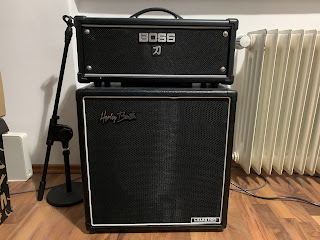
Review: Harley Benton G112 Vintage


Hello everyone and welcome to this week's article!

I was looking for a small 1x12 cabinet for my travel setup (which consists in a Boss Katana 100 head), and my idea was to look for one with a Celestion Vintage 30 speaker, which is a standard for rock and metal.
The V30 speaker is particularly good for hard music because it can handle high wattages (60w nominal power rating) and because it provides a strong low-mid thump and mid range, which is particularly suited for lower tunings and palm muting.

While browsing around for cabinets, I've stumbled upon the Harley Benton G112 Vintage, a cabinet made in China and imported from the German Shop/Distributor Thomann, and given the surprisingly low price (lower than the price of the speaker itself if bought separately!) I have decided to give it a try.

The cabinet is black, of the size of the average 1x12 combo amp, not particularly light nor heavy, and with a half-open back to retain a bit more low end, which is useful since it's quite small.
On the back there is only one input, 8 ohm mono, which makes it not very flexible but it's the most common choice and it's supported by basically every amp, and in general this cabinet has a pleasant look and feels solid in build quality. 

How does it sound?
It sounds quite well! The speaker has the unmistakable V30 tone, and the Katana head roars through it with no problems, plus this setup makes also a very good companion for home recording, because the Katana head can be used also at lower wattages, and the cabinet lends itself nicely for any type of microphoning, also at low volumes.

Do I suggest it? Hell yeah! At this price it has basically no competitors, and I don't see any reason not to buy one.

Thumbs up! 


Specs taken from the website:


- Equipment: 1x12" Celestion Vintage 30 speaker

- Power rating: 60 W

- Impedance: 8 Ohm

- 18 mm Poplar plywood housing

- Half-open rear wall

- Rearloaded

- Trim strip

- Carrying handle

- Dimensions (W x H x D): 460 x 470 x 299 mm

sabato 9 ottobre 2021

Review: Audio Assault Blacksun (with video sample)


Hello and welcome to this week's article!
Today we're going to review an amp sim from Audio Assault that is currently free if you are member of the AA mailing list: the BlackSun!

The BlackSun is an emulation of a Blackstar head, probably an HT Club 50 (even if it's not explicitly stated), which is a 2 channel tube head with EL34 tubes.
Among the other features, this plugin has a preset manager with several presets ranging from clean to hi gain, a "double track sim" which emulates recording 2 layers of the same riff, the "my amp" function which generates some slight hardware variation unique for every registered plugin, and it has a knob that is typical for Blackstar amps, (in the original amps is called ISF, in this plugin it's called Mode), which lets you choose between a "Marshall" and a "Mesa Boogie" voicing and all the gradients in between;
a "Marshall" voicing will mean a tone with more pronounced upper mid range, slightly more nasal and twangy, while a "Mesa Boogie" one will be a with a stronger low-end and more scooped mids, that lets out more high end than upper mids.

As per the other recent Audio Assault amp sims, also this one features a very nice, resizable GUI, 3 stompboxes (Gate, Booster and Tube Screamer), an FX Rack in the loop with Graphic EQ, Delay, Reverb and Chorus, a Dual Cab Loader which lets you also move around the microphones with any ir (thanks to a system of eq and envelope filters I imagine), and many other features.

How does it sound? It sounds very well, in my opinion, especially with the "mode" knob in the "Marshall" side, because a problem that I have found in some Audio Assault amp sim is the fact that they are all very "American sounding", for modern metal, while this one can replicate very well a British tone that is also hi-gain, tight and defined, and that it has that nice clear upper midrange.

This makes Blacksun one of the most versatile Audio Assault amp simulators, because the original head itself is extremely versatile, it has a lot of gain and tonal possibilities and I think anyone should definitely try it, also because they just released a pack with '80s style presets which adds a lot of fun to this amp.

Thumbs up!


Specs:

- 2 channels

- 3 stompboxes (gate, boost and screamer)

- Dual Cab loader with IRs created by Seacow cabs

- FX rack with eq, delay, reverb and chorus

- preset manager

- mode knob to change the flavor of the amp


Become fan of this blog on Facebook! Share it and contact us to collaborate!!

sabato 25 settembre 2021

Audio Assault - Bulldog (with video sample)


Hello everyone and welcome to this week's article!

Today we are going to review the latest virtual amplifier by Audio Assault: the Bulldog!

The Bulldog is the amp sim of a VHT Pitbull, a 3 channel hi-gain tube head famous for being very tight and aggressive (and also very expensive).

This virtual amp is quite a faithful representation of the original one and offers several solutions to make it a very flexible suite: a tuner, 3 stompboxes (gate, booster and a Tube Screamer emulation), a rack with 3 effects (a graphic eq, a delay and a reverb), a preset manager, the function "my amp" which modifies slightly the tone in a way that is unique for every purchase (like it happens with real amps, which usually never sounds exactly the same among them) and a handful of IRs made just for this amp.
The fact that there are few IRs compared to other Audio Assault amp sims can be due to the fact the one I'm trying it's a beta version, but if it's not, I consider this a good thing anyway, since they clearly took time to pick the IRs that sounds the best with this amp rather than put hundreds of them and forcing the player to navigate for hours between them before finding one that suits the head.

Among the other features it's worth to mention the resizable UI and the double track emulation, which doubles the track you are recording in order to make it sound like there is a second layer, and it can be a good songwriting tool, to put down ideas faster and that already have that "wall of sound" feeling.

How does it sound?

This is clearly one of the best and most usable Audio Assault amps, they have improved constantly through time and in this specific one I must say (also thanks to a good choice of impulses) the low end is very present and in focus (which is something not very common in amp sims, realistic low mids that doesn't sound muddy) and the highs are very clear and defined, making this a very usable amp simulator.

This plugin is good not only for high-gain metal tones (in terms of pure metal sound Sigma is still superior), but also for clean and crunchy ones, which sound very warm and credible, and I can only suggest anyone interested to check it out.

Thumbs up!


Specs taken from the website:


- 3 channels

- 3 stompboxes: gate, booster and Tube Screamer

- Fx rack with eq, delay and reverb

- Tuner

- L, R and Stereo Routing

- 2x, 4x, 8x, 16x Oversampling options

- 2 Graphics engine

- My Amp Feature for an unique tone

- Double track emulation

- Presets system


Become fan of this blog on Facebook! Share it and contact us to collaborate!!

sabato 11 settembre 2021

Review: Fender '65 Deluxe Reverb


Hello everyone and welcome to this week's article!

Today we're going to review one of the most historical guitar amps of all times: the Fender '65 Deluxe Reverb!

The '65 Deluxe Reverb is one of the most iconic amps ever produced by Fender, and its latest reissue is still on sale today from the producer, hand assembled in the USA with premium components.
This amp, historically, is suited for Country, Blues, Classic Rock, but in general its clean tones have been loved and used by guitarists from all genres.

The amp features 4 inputs: 2 for the normal channel and 2 for the vibrato one (the difference between the 2 inputs is that input 1 is 6db louder, so you should use it fwith lower output guitars, while input 2 should be used with high output ones).
Instead of the usual overdrive channel, channel 2 is a vibrato channel, meaning that has a vibrato effect always on, and there is also (only for this second channel) a reverb, with the knob in the amp acting as dry/wet mix control. 
Finally, to be noted that in the eq section there is no mid control, only bass and treble.

How does it sound? Let's start by saying that like all amps of this type, even if it's a small 22w combo, this amp is LOUD, and the more you crank it towards the breakup, the more the sound becomes harmonically rich (althought a bit noisy) and it can enter also into mild overdrive territories.
The basic clean channel is the definition of Fender clean: squeaky clean, with a lot of attack and top end but at the same time with deep bass, a combination that makes it sound almost like a piano, while the vibrato channel is similar to the clean one but with an adjustable vibrato effect, which can be useful in certain genres, and a very good reverb.
If you need only the reverb you can lower the vibrato settings to the minimum, until it basically disappears, and you will remain with another normal channel to which you can apply the reverb.

Regardless of the genre you play, this is an amp I suggest anyone to try, because it's the history of guitar and because it's featured in countless records, from the '60s up to now, and it lets us peek into a time in which in the amps there were different features, and maybe guitarists also had different needs.

Thumbs up!


Specs:


- 2 Channels

- Power 22 W

- Equipped with: 1x 12" Jensen C12K speaker, 8 Ohm

- Controls for: Volume, treble, bass, reverb, speed, intensity

- 4 Inputs - 2 per channel

- Speaker out

- Spring reverb

- Tube Vibrato

- 4 Preamp tubes: 12AX7

- 2 Preamp tubes: 12AT7

- 2 Power tubes: 6V6

- Dimensions (D x W x H): 24.1 x 62.2 x 44.5 cm

sabato 28 agosto 2021

Review: Blackstar ID:Core Stereo 100


Hello and welcome to this week's article!

Today we're going to review a very interesting digital combo, which is an evolution of the smaller ID Core range (which are up to 40w, while these 2 larger ones are 100 and 150w) and which have as main difference the fact that instead of having small full range speakers, these ones have 2x10 guitar speakers: the Blackstar ID:Core Stereo 100!

The choice of full range speakers or 10 inches speakers may set somebody off, since the standard for guitar is a 12 inches one, but this is a compromise solution to fit 2 speakers in a smaller, lightweight package (which is almost as small as the size of a regular 1x12 combo) and allowing the player to take full advantage of the "Super Wide Stereo" technology, which lets us playback an mp3 (via Aux) and practice along with it listening in stereo, while most of the practice combo amps, having just 1 speaker, lets you playback only in mono.
This speaker choice targets the amp towards practicing musicians which play more at home along with mp3s than for live musicians, since live there is usually more need of a 12 inch speaker to have all the low end thump, which is less strong in a 10 inch one, but at the same time with 100w there is enough power to stay on top of a live drumkit, also for rehearsals.

Besides the speaker, the amp offers 6 voicing controls, which range from clean to the most extreme hi-gain, a looper up to 30 seconds, 12 effects, a software suite for in-depth editing, usb recording, speaker emulated out and so on, making the ID:Core a Swiss army knife for the practicing musician, and the 100 and 150w versions have enough power to play live with no problems, all in a convenient 12.5kg package.

How does it sound? It sounds quite well! Blackstar Amps, especially for high gain, are some of the best sounding practicing amps, with musical mids and the proprietary ISF, Infinite shape feature, which is a knob that lets you pass from a US type of gain to a British one and everything in between.
The cleans are good and the distortions sounds almost "produced"; in this the amp the tone in general is less raw and "in your face" than a Boss Katana, but it sounds brighter (maybe also because of the speaker choice) and very pleasant, it just has a different grain and you'll have to compare them to find which one is more suited for you.

Thumbs up!


Specs taken from the website:


- 100W (SUPER WIDE STEREO 2x50W)

- 6 Blackstar voices

- Looper with 30 seconds record time and infinite overdubs

- Patented ISF control

- 12 vintage style effects including Octaver

- Store up to 36 sounds

- USB Audio

- FREE INSIDER software

- Stereo MP3/Line In

sabato 14 agosto 2021

Review: Rivera Clubster 25 112


Hello everyone and welcome to this week's article!
Today we're going to talk about a legendary combo produced by Rivera amps in 2009, of which the latest version is still today on sale: the Rivera Clubster 25 112!

Rivera Amplifiers comes from the mind of Paul Rivera, a technician which worked also for Fender before opening his own brand, and today Rivera amps offers a full lineup of tube amplifiers which are known for their uncompromised sound and build quality.

The Clubster serie has several versions, 25w, 40w, with a 10 inches speaker and a 12 one, and the one I'm reviewing today is the 25w, 12" one.
The Rivera Clubster is a 2 channels tube amp, with several push-pull knobs in the eq to shape it furthermore and a spring reverb, but the most surprising thing is the volume and headroom: thanks to its oversized transformer, even the 25w version is more than capable of staying well above a rock drumkit, both in rehearsals room and live, all in a compact combo format.
The amp features 2 preamp tubes and 2 6V6 power amp ones, and immediately after switching it on you can feel the tube tone, which is loud, mid rangey, in your face and full of harmonics. 
The clean channel is really clean and chimey, and it has quite a lot of headroom considering it's 25w (obviously if you need even more headroom you must switch to the 40w version), and the high gain one has a very credible tone: balanced, pleasant and that it sounds almost "mix ready".
The overdrive channel can easily deliver heavier tones for genres such as hard rock without the need of a booster; a booster is necessary if you need the type of tightness used in death or thrash metal, though.
This said, I have seen a band using it also to play Dream Theater style (without a booster), with a 7 strings, and the tone was very similar to the Mesa one used by Petrucci: mid rangey, creamy and with a very loud power-amp roar.

The version currently on sale is the Clubster Royale Recording, which features also a loadbox integrated and speaker emulated output, so that you can record also bypassing the speaker, among the other new features, but the original Clubster soul is still there.

Still today a great, uncompromise sounding amp! Thumbs up!


Specs taken from the website:


- Channel 1 controls: Volume, bass (pull switch for boost), middle, treble, master

- Channel 2 controls: Volume (pull switch for channel selection), treble (pull switch for bright), bass

- Common front-panel inputs and controls: 1/4″ High Gain input, 1/4″ footswitch input, reverb control, presence control, power on/off switch

- Rear-panel inputs and outputs: 1/4″ effects loop send, 1/4″ effects loop return, 1/4″ line output, 1/4″ 

- external speaker output

- Preamp tubes: Two 12AX7A

- Output tubes: Two 6V6GT

- Output power: 25 watts RMS into 8 ohms

- Speaker: 12” Celestion 70/80

- Footswitch functions: Channel switching, reverb on/off (footswitch is included)

- Reverb: Accutronics® 3-spring reverb

- Height: 19.25″ (w/feet)

- Width: 18.25″

- Depth: 12″

- Weight: 38 lbs

- Cabinet material: 5/8″-thick plywood

- Construction: Dadoed joints

sabato 31 luglio 2021

Review: Fender Mustang GTX50


Hello and welcome to this week's article!

Today we're going to review a combo amp which came out in 2020, but that actually is (along with the LT50) the latest iteration of Fender's take on digital combos, with presets, amp simulators, effects etc all in the box, all at an affordable price: the Mustang GTX50.

The Mustang serie is the low price digital serie of amps produced by Fender and aimed to the beginners, and even if I don't remember the year the first amp of this serie was produced, I think it was 2010 max, I know several updated versions have been put in the market, and this GTX keeps on building on top of the original one.

In 2020 Fender proposed 2 versions of the Mustang: the LT ones, (25 and 50w), which cost around 100$ less than the GTX and offer a stripped down software with less editing possibilities and it's aimed to the beginner guitarists and the GTX one, which offers a full range of in-depth parameter editing, and many more presets and tools to carve your sound.

I had the chance of trying the GTX (unfortunately without using the app Fender TONE, which is new for this version and allows the player to edit the presets and download new ones from the cloud), and I must say I have been impressed by the amount of bells and whistles this small amp features: bluetooth, fx loop, lcd color screen, 200 presets, usb to turn the amp into an audio interface, aux, headphone out, wi-fi, Celestion speaker and so on, plus the design is quite cute.

How does it sound? Well, it depends on the genre you need: if you like the typical Fender cleans, which are ringing, chimey, with emphasis on the high frequencies, this amp is quite good in recreating them. Moving towards more crunch territories though, the amp starts showing its flaws, which makes it (and its previous iterations) more similar to the Line6 Spider: the distortions sound quite digital, meaning compressed, scooped, scratchy, and the higher the gain, the more the problem is noticeable.

The conclusion is that this is a good bang for the buck if you like clean tones or slightly overdriven, but if you're looking for high gain simulations, there are much better candidates around, for example the Boss Katana or the Blackstar ones, unless you are in for a long and deep tone editing session.


Thumbs down!


Specs taken from the website:


- New models include: Fender classics like the Blues Jr and Vibro King, as well as other amplifers including JC Clean and Silver Jubilee

- New effects include: Models of classic Overdrive, Fuzz, Delay and Pitch Shift effects

- Newly-designed stage-ready cabinet and cosmetics

- 12-inch Celestion® guitar speaker

- 200 onboard user presets that can be modified for any style of music

- All-new Fender TONE 3.0 for iOS and Android for deep editing, preset browsing from the Fender Tone community, preset back-up and restore, and more

- Upgraded seven-button footswitch (optional) features individual bank up and down functions and easy effects selection, as well as a tap tempo and 60-second looper


Become fan of this blog on Facebook! Share it and contact us to collaborate!! 

sabato 19 giugno 2021

Review: Audio Assault Klank (with video sample)


Hello and welcome to this week's article!

Today we're reviewing a new bass amp simulator from Audio Assault: Klank!

Klunk is the simulation of a preamp pedal that looks very simlar to some of the Darkglass ones: it features 3 levels of eq (one with knobs and two graphic ones, one of which in the rack after the preamp), 2 types of distortion, 2 shaping flavors (vintage and modern), compressor, noise gate, tuner and a dual IR loader with many bass IRs by Seacow Cabs.
One thing to notice about the ir loader is also the fact that you can move freely the virtual microphone on the speaker not only with the bundled irs but with any ir! 

This simulator is the third one for bass, after Bassgrinder and Duality Bass Studio, and it's the first one to emulate a pedal preamp, and it's the most advanced of the 3, it has also a very nice resizable UI.

How does it sound? It's sounds quite good, as you can hear from the sample, but it sounds also very versatile, thanks to all the IRs and the eq capabilities, which makes this plugin very versatile in terms of tone shaping.

What would I improve in the future? Here's my suggestions to Audio Assault: I would ship the plugin (not only this but all of them, since it's a problem that I'm encountering often) with a leaflet in pdf that explains exactly what each knob and switch do, because without it we might be lacking or misunderstanding some function; I would also add some graphic representation of the compression (be it a vu meter with the needle, or with the '80s leds, or in any other form), because it would help when doing some fine tuning and would spare us the need of an external compressor.

All in all, when looking for a very quick metal tone I still prefer Bassgrinder, for its capability of separating the distorted part and the clean part and because it features a limiter, but if you're looking for versatility and tone shaping capabilities you can't go wrong with Klank!

Thumbs up!


Specs taken from the website:


- 2 distortion modes

- 2 shaping flavors

- Graphic EQ

- Double IR loader with custom bass amp IRs from Seacow Cabs

- Rack with 9 bands graphic equalizer and compressor

- tuner, noise gate


Become fan of this blog on Facebook! Share it and contact us to collaborate!!

sabato 5 giugno 2021

Review: Nembrini Audio Crunck v2 (free Vst plugin with video sample)


Hello everyone and welcome to this week's article!

Today we're going to talk about another interesting plugin, this time free, the almighty Nembrini Audio Crunck v2

Crunck v2 is the second version of Crunck, the first plugin designed by Igor Nembrini in the beginning of his career in DSP development more than ten years ago.
It's a virtual amplifier with a very clean and simple layout, which features all the classic controls of a real amp (gain, master, presence and eq section), and which has a bypassable cabinet section with a V30 speaker impulse response.

This virtual amplifier, which is one of the few ones available also for Iphone and Ipad through the App Store (free as well), is quite versatile and provides a very warm tone, with a gain knob that allows to dial a huge amount of gain, and lets you achieve quite a wide range of tones.

How does it sound? I'd say it sounds quite well, but it's more geared towards the rock and hard rock tones than the metal ones, since it has a lot of energy in the low mids that is not easy to get rid of (in the sample I have used an overdrive in front), so if you are looking for a creamy bluesy tone, or a fusion lead tone, this it's probably the plugin for you.

Anyway since it's free I suggest everyone to go check it out in the Nembrini website, a website that offers also other free plugins, along with paid ones.

Thumbs up!


Specs:


- 3 bands EQ

- bypassable cabinet simulator with built-in IR

- Gain, Master and presence knob

- available in all plugin formats and as Apple store app


Become fan of this blog on Facebook! Share it and contact us to collaborate!!

sabato 22 maggio 2021

Review: Audio Assault Hellbeast v2 (with video sample)


Hello and welcome to this week's article!

Today we're going to review the version 2.0 of another Audio Assault virtual amplifier: the Hellbeast v2!

The Hellbeast is probably the heaviest and most extreme virtual amp ever made by Audio Assault, and it's modeled on the Randall Satan amp, an amp now discontinued (but that due to some licensing change has later been produced by Fortin under the name Fortin Natas). 

This amp has the particularity of having a master gain knob and 2 other gain knobs which lets you dial separately the gain in the lows and the highs, which is a great thing if you want a tight low end, because you can keep the gain lower in the lows (so the lows are clean and fast) and raise the gain more in the high end to make the sound more aggressive and modern.
On the other hand, if you prefer a more vintage type of distortion you can raise the gain in the lows, and you will have a tone more similar to an Orange amp, which will be good for stoner, doom, or '70s hard rock.

As in all the v2 amps from the producer, also Hellbeast has all the extra features that were lacking in the first version: a completely redesigned, resizable UI, 3 channels, stompbox, rack and cab sections completely redesigned with all new IRs made by Seacow Cabs, a preset manager and (exclusive to this one) a double tracking simulator, which basically takes your playing in real time and make it sound like it's 2 layers of guitars, which is good to create some wall of sound especially during songwriting, if you don't want to spend time double-tracking everything.

All in all this is yet another good simulator that got further improved, I can't say it's my favourite from Audio Assault, it's a bit too extreme for my taste, but it actually gives you some extra flexibility compared to the others, allows you to obtain tones to a level of fine-tuning that many other sims cannot produce, and the new features are absolutely worth the upgrade.

Thumbs up!


Specs
:


- 3 channels

- 3 stompboxes: Gate, Boost and Drive

- Rack Fx: 9 band equalizer, Delay, Reverb

- Dual cab IR loader with dozens of Seacow Cabs IRs

- Preset manager

- Double tracking simulator

- Resizable user interface


Become fan of this blog on Facebook! Share it and contact us to collaborate!!

sabato 8 maggio 2021

Review: Audio Assault Rvxx v2 (with video sample)


Hello everyone and welcome to this week's article!

Today we're going to review the version 2.0 of an amp sim we have already reviewed (here) but that after the latest update it has been changed quite substantially: the Audio Assault RVXX!

The Rvxx is the Audio Assault take on the Revv G20, the 20w amp by Revv, a small but very angry tube head, and this new version has received the same treatment received by Sigma 2.0: they have added 3 stompboxes, 3 rack effects, a dual cab ir loader with many good impulses by Seacow Cabs and a preset manager with several presets.

On top of that, the interface has been completely redesigned and now it is fully resizable, making it very versatile.

How does it sound? Better than the original, because the stompboxes now are more, so you have more versatility, and the cab section has definitely seen an improvement.
Compared to the Sigma 2.0, you can still tell that this unit has less watt, because it's a bit more upper-mid rangey and with less low end, but with the right impulse to counterbalance it, this characteristics are tamed, and you can enjoy the strong presence and bite without that thin and boxy vibe that sometimes comes with low wattage amps.

All in all this is a very usable amp simulator, oriented for metal, with a very good quality to price ratio, and I really suggest everyone to try it, it could make a good addition to your collection.

Thumbs up!


Specs:


- 2 channels

- 3 stompboxes: Gate, Boost and Drive

- Rack Fx: 9 band equalizer, Delay, Reverb

- Dual cab IR loader with dozens of Seacow Cabs IRs

- Preset manager


Become fan of this blog on Facebook! Share it and contact us to collaborate!!

sabato 24 aprile 2021

Audio Assault Sigma v2 review (with video sample)


Hello everyone and welcome to this week's article!

Today we're going to review the version 2 of a virtual amp which has already been reviewed on these pages, the Audio Assault Sigma!

Sigma is a plugin which is a bit special in the Audio Assault lineup, I think it started a new course in terms of interface, features and overall sound quality, and this version 2.0 adds a new interface, more channels (now they are 3), 2 more knobs (2 independent gain controls for low and high frequencies), a booster, more impulse responses by Seacow Cabs, a Delay and a Reverb. 

The amp structure is basically the same, but these extra features allows you to fine tune your tone much more, adding a lot of versatility, especially in the low gain territories.

The new impulses are also quite usable, as you can hear from the sample (I have used the Sigma 4x12 one), and all in all I think it's a great upgrade which makes it, in its price range, one of the best virtual amps on the market.

Now Sigma comes also with an array of presets which have the function of showcasing the amp's versatility, although I would have preferred to have them called with a name that describes them, instead of a number.

My only suggestion is to add a tuner and to optimize a bit the stereo version: usually one puts the stereo version of a guitar plugin in the guitars stereo buss to save some cpu, but in the case of this plugin it's less cpu hungry if used in 2 mono instances, in the individual guitar tracks. 

This is a really good plugin, especially for metal tones but also for clean ones, and I suggest everyone to download the demo version and try it out!

Thumbs up!


Specs:


- 3 channels: Clean, Crunch and Lead

- 3 stompboxes: Gate, Boost and Drive

- Rack Fx: 9 band equalizer, Delay, Reverb

- Dual cab IR loader with dozens of Seacow Cabs IRs

- Preset manager


Become fan of this blog on Facebook! Share it and contact us to collaborate!!

sabato 10 aprile 2021

Audio Assault AHM 5050 (with video sample)


Hello and welcome to this week's article!

Today we're going to review a new amp simulator which emulates the most famous metal amplifier in the world: the EVH 5150, both in 6L6 and EL34 version: the Audio Assault AHM 5050!

This amp sim enters a very crowded arena, since this is the most used amp for many genres of metal (from thrash to the most extreme ones), and there are already many contenders to the throne of the best 5150 simulator, like the STL Andy James, the Peavey Revalver, the TSE X50 and the Neural DSP Nolly (although I think this one emulates a customized version).

This Audio Assault take on the legendary 5150 has some ace up its sleeve: it lets you blend between the 6L6 and el34 power tubes seamlessly with the turn of a knob, which is a very cool idea and recreates well the character of the two versions (and all the shades in between), it comes loaded with a wealthy amount of presets and impulse responses, which lets you have fun right away, it has several effects, booster, drive, gate, delay, reverb and so on, and basically the only thing missing to make it a real Swiss army knife is a chorus (in the rack section). 

Tone-wise it has its own character (to be noted that you can also switch between the standard version and the "My Amp" one, which alterates some value, because every amp sounds a little different since all electronic components have a certain tolerance), and the "my amp" function slightly alterates randomly some value, different for each version, to make each instance of the plugin unique.

How does it sound? This is one of the best sounding Audio Assault amps, because, besides the fact that the original hardware is one of the most balanced, tight and ductile amps in the world, the plugin manages to recreate that midrange, that can go easily from honky to scooped but never muddy, that tightness in the low end and the clear attack which are the trademarks of the EVH 5150.
The only thing I would still work on are the impulse responses, which sometimes sound a bit boxy and too mid rangey (in this video sample I'm using an external IR).
Impulse responses are today the single most important thing in an virtual amplifier, they can make or break a tone, and in this the competitors (especially STL Tones and Neural Dsp) are a bit forward.
Nevertheless this plugin is one of the best bang for the buck around and will give you a tons of fun, and good tones in the studio!

Thumbs up!


Specs:


- 3 channels: Clean, Crunch and Lead

- Balance Knob: it lets you dial precisely the tone between the 6L6 and the EL34 version

- 3 stompboxes: Gate, Boost and Drive

- Dual Cab Loader with numerous IRs

- FX Rack with Eq, Delay and Reverb

- Standard amp / My amp function


Become fan of this blog on Facebook! Share it and contact us to collaborate!!

sabato 27 marzo 2021

Review: VTarAmps Proto Four (with video sample and download link)


Hello and welcome to this week's article!

Today we're going to review a very good, free amp simulator by VTarAmps: P.R.O.T.O. Four!

This amp sim is a new version of  MegaFuzzieMKIV by Vadim Taranov, a virtual version of the overdrive channel of a Mesa Boogie Mark IV and it adds many new functions to the original one.

The interface looks like the one of a Mesa Boogie Dual Rectifier, but the tone is the one of a Mark IV, and the amp offers, besides the usual gain knob, also two separate controls to dial the gain for the low and the high frequencies, plus the two sections (preamp and power amp) are bypassable individually.

On the top of the amp there is also the fuzziness control, which lets you add fuzz to the tone and to control the fuzz character, from dark to bright; there is also a fizz control, which sets the "acidness" of the amp.
All these functions give the Proto an impressive versatility: the amp allows you to achieve a very wide range of tones, from crunch to any type of fuzz, up to the extreme metal without problems, also because an eq section with a very wide excursion: with the mid knob it's possible to obtain a very scooped sound already at 11'. 

The amp sim sounds very well, as you can hear from the sample: the interface is cool and pretty intuitive, and it's easy to achieve a good tone: the only thing I can do is to suggest you to download it and try it for yourself!

To be noted also that I see in the interface (and the manual) also the Ugritone logo, which is the evolution of a software house we used to know (and review) under the name "It Might Get Loud": I suspect something is cooking, can't wait to see how this collaboration will pan out!


Thumbs up!


Become fan of this blog on Facebook! Share it and contact us to collaborate!!

sabato 13 marzo 2021

Review: Seymour Duncan P90 Stack


Hello and welcome to this week's article!

Today we're going to review a legendary pickup, the Seymour Duncan P90 Stack!

Let's start off with some history: P90s were pickups created originally by Gibson for their guitars in the second half of the '40s, and they are single coil pickups built in a slightly different way from the Fender single coil ones;
the P90 has the wires wider and shorter than the typical Fender pickups, and this made the sound warmer and less bright, a bit closer to the tone that later Gibson developed into the humbucking pickups.

The main difference with the humbuckers was, in facts, the hum, a background noise typical of single coil pickups that also the P90 had, until many aftermarket producers (and Gibson itself) started producing noise canceling versions of this pickup, which retain the tonal characteristics of the original one but without the noise.

The one we are reviewing today is the Seymour Duncan P90 Stack, but the brand actually produces a wide range of P90 pickups, some more vintage sounding, some more hot, and out of them all, this is the one that is the closest to the original Gibson S90 tone.

Look-wise this pickup is quite similar to the original one: a soapbar that fits a humbucking slot, but with only one line of poles, and sound wise it's a very good sounding pickup, the type of pickup that you could hear at home in any classic rock, punk, blues, jazz, alternative or country record, and it's been used by countless musicians, from Green Day to John Lennon, from The Who to Muse, from Black Sabbath to Bon Jovi.

This Seymour Duncan version of the P90 sounds every bit as good as the original Gibson one: tone-wise it's the perfect halfway between a single coil and a humbucker, giving clarity, note separation and definition when needed, but also being warm and extremely pleasant with distortions too, because it smoothes the edges of the distortions making the tone always pleasant, and because it doesn't have the typical razorblade tone of the distorted single coils.
To be noted that also some metal musician likes to use it, especially in the neck position, because it allows to obtain beautiful, saturated clean tones which can sometimes be too muddy with a neck humbucker.


All I can say is that this is a great rock pickup, and one of the best to be put in the neck position in general. Thumbs up!


Specs taken from the website:


- DCR: Bridge 31.6k

- Magnet: Alnico 5

sabato 27 febbraio 2021

Review: Seymour Duncan '59 neck


Hello and welcome to this week's article!

Today we're going to review a legendary humbucking pickup (click here for an article dedicated to humbuckers), which ended up also in our top 10 pickups list: the Seymour Duncan '59!

The '59 is a "p.a.f." pickup, which means "patent applied for", and indicates pickups that try to recreate the tone of those mounted on '50s and '60s Gibson guitars, with medium output but with a good, musical mid range, and with a present but not "scratchy" high end.
This style of pickup is still today extremely popular, and it inspired a wide production of clones from many manufacturers, to the point of almost becoming a standard.

The neck version of the '59 is probably the most popular Seymour Duncan neck pickup, and for good reasons: it's warm and full sounding thanks to its alnico 5 magnet, but it has a precise attack and the mediums are not too pronounced, resulting in a perfect balance both for clean parts (btw there is also a coil split version) and for high gain parts, since it sounds good also for high gain solos.

For my genre (I play mostly metal) a pickup like a p.a.f. would be too weak for the bridge position, I need higher output ones especially for a matter of low-end tightness and definition, but in the neck position a pickup like this is great, because it captures all the nuances and it's fantastic also when lowering the volume knob.

In conclusion this is the pickup that I usually suggest when someone asks me which passive humbucker to put in the neck position, since it sounds very balanced and pleasant for basically any genre, from jazz to metal, and you should check it out too, if you have the chance.

Thumbs up!


Specs taken from the website:


- DCR: Neck 7.60k

- Magnet: Alnico 5

- Cable: 1c Braided Shield, 4c Shielded

- Type: Passive

sabato 13 febbraio 2021

Review: POD 2.0


Hello and welcome to this week's article!

Today we're going to make a long awaited legacy review from one of the most important pieces of guitar hardware of the latest 20 years: the Line 6 Pod 2.0!

This revolutionary piece of gear (that we have described along with its other iterations in our article "The Battle of PODs") came out in the year 2000, and (along with the first model, which came out 2 years before) contributed greatly in making digital amp modeling a viable option not only for beginner guitarists but also for professional ones.
How did they do? Well I guess the technology was starting to be mature enough to allow the guitar player to obtain sounds that were a bit richer in harmonics and fuller in terms of frequencies, compared to the '90s digital processors, which often sounded like fingernails on a whiteboard and were not a viable option if you wanted tone to do anything more than doodling in your bedroom.

This 2.0 version has been the one that exploded, in terms of public recognition, and became very popular both in studio and live environment, because it was user friendly and yet packed several interesting features, such as 32 amp models which could be used to drive a real power amp or mixed and matched with the integrated cabinet models, 16 effects, several inputs and outputs, and 36 presets.

The amp models were covering the whole guitar spectrum, from the classic Fender cleans to a high gain Mesa Boogie Dual Rectifier (plus there was also some custom Line6 model such as the "Line6 Insane"), the cabinet simulations were available in several brands and sizes (for example 1x12, 4x12, 4x10 etc...) and the effects were the most common ones and there were also several effect combinations.

How does it sound? As I have said, compared to the previous digital amp sims such as the '90s Zoom ones there is a huge leap forward: for once the high gain tones are usable, and even if the distortions are still quite scratchy, there is already a decent amount of musical mids, and also the effects are more than usable.
Probably the biggest bottleneck today is represented by the cab simulators, which today sound quite dated, but already someone on Youtube has shown that by using this unit together with modern impulse responses you can still obtain sounds which are competitive today, and this tells us a lot: the cab simulation is still today probably the most important part in a digital guitar rig.

Does it deserve still today to be bought?
Actually the technology of POD has been used, with some update, for basically 20 years, for example in the Spider Combo lineup, or in the Pocket POD and so on, so the hardware has proven to be good and reliable, but today the latest iteration of the POD is the POD GO, which features a completely different hardware and software: it is based on the one of the Line6 Helix, which is much more advanced.
If you are considering of buying anything from the Line6 family, probably the POD GO today is the bang for the buck to check out!


Thumbs up!


Specs:


- Amp Models: 32, customizable

- Digital Effects: 16

- Factory/User Presets: 36

- Headphone and Direct Out: 1/4 in. TRS

- Mono/Stereo: Stereo


Become fan of this blog on Facebook! Share it and contact us to collaborate!!

sabato 30 gennaio 2021

Review: Behringer V-Ampire LX112 combo


Hello and welcome to this week's article!

Today we are going to make another legacy review, this time of a Behringer combo which was quite popular among the beginner guitar players in the mid-2000s, because at least back then the German company was known for producing cost effective music gear, which often were inspired by products created by popular brands, but that often featured a very good technical spec sheet.

When Line6 presented the POD in the end of the '90s, this device represented a paradigm shift in terms of guitar amp simulation, finally simulators were leaving the niche of toys and were starting to be used also from professionals, and few years after Behringer launched its interpretation of this new wave of digital amp sims, the V-Amp, which had similar shape and features, but that added even more sound possibilities, and along with it they released also the V-Amp Pro (the rack version) and the V-Ampire, a combo which basically mounted a V-Amp Pro on a speaker, and this happened even before Line6 released its first combos based on the POD.

All this at a fraction of the price of the Line6 versions.

The V-Ampire LX112 is a now discontinued digital 1x12 combo with 120w RMS (there is also a 2x12 version), or 2x60 RMS stereo, which back then had features that almost no other combo had: 32 amp models, 15 cab simulations, 16 effects and so on, all controllable via MIDI, and given the price it was quite popular.

Tone wise the sounds were surprisingly good for the time, they were usable for any genre, also in a live environment (even if the power amp was weaker than the numbers tell), and held up also compared with an actual POD, except for probably generating a bit more noise.

So, where is the catch? Where were they cutting costs? Simple: build quality.
The amp was extremely poorly built: the first one I bought (new) made a lound bang the first time I turned it on, producing dense black smoke, and when I called the store they tried also the others that they had in stock and they all had the same problem, therefore I had to wait several weeks for the arrival of a new batch, and when I got mine replaced, it finally worked.

The poor build quality showed itself not only with the power amp failure, but also with the knobs: they were made of extremely thin and weak plastic, and the first time I carried the amp in a car, just because of the vibrations, FOUR knobs fell from the amp (and no, I wasn't racing the Paris Dakar rally).
After this experience, I decided to sell it and to buy something with a less shiny spec sheet but with a stronger build quality, and since then I learned my lesson.

Nevertheless, if you need a very inexpensive combo to doodle around in your room and you don't plan to move it EVER, for its street price of today (around 70/80 bucks) it could still give you some fun.

Thumbs sideways!


Specs taken from the website:


- 2 x 60-Watt guitar modeling workstation 

- 32 amp models

- 15 speaker cabinet simulations 

- 16 multi-effects

- 12'' Bugera Vintage speaker for classic sound reproduction

- 120-Watt mono or 2 x 60-Watt stereo operation with additional cabinet (optional)

- 125 memory locations, divided into 25 banks of 5 presets each

- rotary controls with dedicated LED indicators

- 15 rear panel connectors allow comprehensive routing to suit virtually any conceivable application-plus MIDI In, Out/Thru

- Full MIDI implementation including program change commands, control change commands and SysEx, allowing extensive MIDI control using our free V-AMP Design editor software for Windows operating systems

- Balanced stereo XLR DI Out with ground lift and switchable ULTRA-G speaker simulation

- Pre-DSP send/return for dry recording and wet monitoring

- Adjustable stereo aux input for line-level signals (CD, soundcard, monitoring etc.)-can be re-configured to feed headphones only, for in-ear monitoring applications

- Frequency compensated stereo headphone output with adjustable volume

- adjustable auto-chromatic tuner


Become fan of this blog on Facebook! Share it and contact us to collaborate!!

sabato 16 gennaio 2021

Review: Engl Savage 120


Hello and welcome to this week's article!

Today we are reviewing a monster of an amp, 120w of tube power, which is considered the most representative of the German brand Engl: the Savage 120!

This head came out originally in 1993, a time in which digital amps were basically useless toys, and in which if you wanted a no-compromise guitar tone you had to really go for the real thing: a super large, super heavy (22kg!) rock amplifier, with a lot of tubes (even in the fx loop) and volume, and if you wanted to reach the perfect tone you had to crank it to the point of being almost unusable.

The Engl Savage is a head that embodies well the attitude of the brand: high priced amps, hand made in Germany, which provides impressive solidity, reliability and mids capable of cutting through the most dense mix: usually if in a concert only one of the 2 guitarists has an Engl amp, the other one gets completely covered.

The Savage offered back then features that were not common (and still today are not), making it a very complete, full optional amp: 2 fx loops, 2 master volumes, 4 channels, and a ton of knobs and switches to craft your tone in a very detailed way.

How does it sound? As I was mentioning, it has a very distinctive mid range which is very cutting, but it features also a lot of flexibility; as a reference, think about a Marshall as an amp with prominent mid highs, while the Engl is an amp with its distinctive tone a bit more in the mid range, slightly more nasal and with a ton of additional gain.

Compared to other popular heads of the brand, for example the Powerball, which came out almost 10 years later, the Savage sounds more classic and in your face (more punchy, like a Marshall JM800 compared to a DSL or a TSL, which sound more modern), a bit less scratchy and slightly more nasal, while the Powerball is a little bit more modern, but both heads retain the undeniable Engl character, which I really love.

Today this amp is sold in its Mark II version, which comes in 60w and 120w and features a serie of extra optionals (noise gate, MIDI switching) and tweaks in terms of tone, which doesn't modify too much the soul of this head.

Thumbs up!


Specs for the Mark II version, the one currently sold:


- 4 Channels: Clean, Crunch I, Crunch II, Lead

- Power: 120 W

- Preamplifier tubes: 6x Engl ECC83 / 12AX7

- Power amp tubes: 2x Engl 6550

- 2 Tube-driven FX loops with separate balance controls

- Noise Gate with adjustable threshold (footswitchable)

- MIDI Channel Assignment and Controller Enable Switch - Write / Copy (for MIDI programming)

- Sound Switching options: Input Lo / Hi, Bright, Preshape, Contour (Clean, Crunch I), Mid Le./Bo., Depth Boost, Gain Lo / Hi, Contour (Crunch II, Lead), Rough / Smooth

- Controls: Gain (separate for each channel), Bass, Mid Lean, Mid Bold, Treble (Clean, Crunch I), Bass, Middle, Treble, Tone Balance (Crunch II, Lead), Volume (separate for each channel), Presence A, Presence B, Master A, Master B

- Controls (rear side): Noise Gate Threshold Level, FX Loop I Balance, FX Loop II Balance

- Outputs: 1 x 4 Ohm, 2 x 8 Ohm, 2 x 16 Ohm, 1 x 16 Ohm

- Made in Germany


Become fan of this blog on Facebook! Share it and contact us to collaborate!!
sabato 2 gennaio 2021

Review: Audiority Dr Drive


Hello and welcome to this week's article!

Today we are going to review a new free Vst plugin, an overdrive by Audiority: the Dr Drive!

This overdrive is modeled after the Horizon Devices Precision Drive, a modified version of the classic Tube Screamer designed by Misha Mansoor of Periphery, which includes 4 knobs (plus the gate switch, which is in a separate part of the GUI):

- Level (which is similar to the Tube Screamer one, except for the fact that the 6 in this corresponds to the 10 in the TS, so use it very carefully),

- Drive, which not too different from the TS one, very usable (I have used this plugin mainly as a booster, though)

- Attack, which determines where is set the attack when picking, from somewhere in the lower mids to the ear piercing highs area, and it's useful especially when creating modern tones,

- Bright, which is basically a tone knob, but tuned a bit more towards the high end, therefore conservative settings are suggested,

- Gate: an intelligent noise gate that basically removes the need of adding a separate gate plugin to our guitar chain, thus saving CPU

What can I say? Since I have tried this plugin, it has become my go-to overdrive for all projects, because it sounds great, it has an integrated noise gate and it gives even more tone shaping tools than the classic Tube Screamer, so I really suggest all of our readers to download this plugin and try it out, it might become your ultimate overdrive plugin for a long time.


Thumbs up!


Specs taken fromthe website


- Analog Modelled Overdrive

- Drive, Tone, Attack and Level controls

- Pre and Post effect gain

- Mix control

- Noise Gate

- Resizable interface